Why the wave speed is
A short note on where the sound speed comes from, why it is always
1. The 1-D acoustic wave equation
The wave equation for sound is built from two physical facts about a thin slab of fluid.
Newton's second law (inertia). The net force on a slab is the pressure difference across it, and that force makes it accelerate:
where
Equation of state (stiffness). When you squeeze the fluid, its pressure goes up. The bulk modulus
A large
Combine them. Put the second equation into the first:
Compare with the standard wave equation
Stiffer fluid → faster wave. Denser (heavier) fluid → slower wave.
Units check.
Note (gases). For a gas,
is the adiabatic bulk modulus, , not the isothermal one. Sound compressions happen too fast for heat to flow out. Using the isothermal value is the mistake that made Newton's predicted speed about 18 % too low.
2. Why it is always
Every small-oscillation medium gives the same balance:
The two second derivatives are forced by physics:
- Time side is
because of Newton. Inertia resists acceleration, and acceleration is the second time derivative ( ). - Space side is
because of how restoring works (see §3).
There are two quick ways to see why the ratio is a speed squared.
(a) Plug in a travelling shape. A disturbance that moves rigidly at speed
The shape
(b) Units make it unavoidable.
A scaling picture ties it together. A bump of width
The
One-line intuition: stiffer coupling snaps the disturbance to its neighbors faster (speeds the wave up), while more inertia makes each point sluggish (slows it down). Because the balance is between two second derivatives, the ratio comes out as speed squared.
This is why the same form appears everywhere:
| Wave | Coupling (restoring) | Inertia | Speed |
|---|---|---|---|
| String | tension | linear density | |
| Sound in fluid | bulk modulus | density | |
| EM wave |
3. Why the spatial term is the second derivative (curvature)
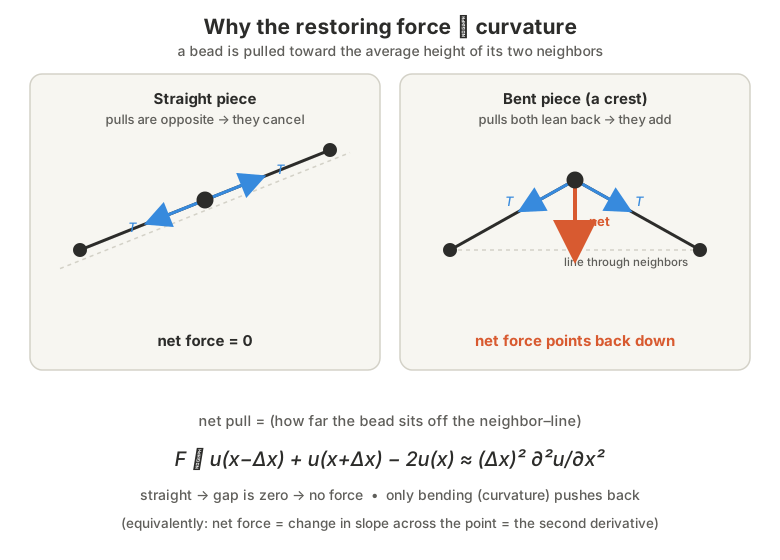
The restoring force on a point comes from how it sits relative to its neighbors, not from its height or its slope.
- Height
alone does nothing — a whole region shifted up feels no internal restoring pull. - Slope
alone does nothing — on a straight, tilted line every point is pulled equally from both sides, so the two pulls cancel. Net force = 0. - Only bending produces a net force. When the line curves, the pulls toward the two neighbors no longer cancel; their leftover points back toward equilibrium.
Quantitatively, a point is dragged toward the average height of its neighbors:
Read the middle expression as "(average of the two neighbors) − (the point itself)": it measures how far the point sticks out from the line through its neighbors. On a straight line that gap is exactly zero; bending it makes the gap — the curvature — non-zero, and that is the restoring term.
Equivalently, for a string under tension the net transverse force is
so a force needs the slope to change, and the rate of slope change is the curvature.
That is why the wave equation's space side is